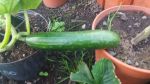
Carrot


The carrot originally came from Afghanistan round about 5,000 years ago, in those days it’s roots were purple or violet rather different from the now familiar orange. We believe an orange carrot was selected in the Netherlands around 1600 , but the story that developed was to honour the Dutch Royal House of Orange which is fictitious but widely believed. Carrots are an excellent source of beta- carotene & fibre & are rich in A, C, K & B8 folate. They are high in anti-oxidants & provide a good source of minerals.

Carrots prefer deep fertile sandy soil If you have stony soils opt for the short root varieties. Carrots do not like manure so don’t grow in freshly manured soil, avoid carrot root fly by covering with mesh or choosing disease resistant varieties.

The orange colours in carrots is due to the presence of beta-carotene believed to enhance night vision. Did you know Mel Blanc who performed the voice of cartoon character Bugs Bunny did not like carrots !!

Always remember  to read sowing instructions on seed packets


Blog & research by Mark Burton (Allotment Secretary)

Successional Sowing

SUCCESSIONAL SOWING

Successional sowing

It is easy to freeze are vegetable’s if we have a glut of crops. Fresh vegetable’s however that have been picked a few hours earlier & cooked always taste so much better. So to avoid growing a glut over the growing season we need to have smaller quantities ripening over a period. Say we are going to use a cabbage each week , take a modular seed tray & plant three seeds, label them with the variety & date. While they are developing pot on into three inch pots. Then three weeks later sow another three seeds as your first set of seeds are developing. Continue the process, that way you wont have too many of the same crop all ready at the same time.

This method can be applied to any crop that you have started in pots.

Blog By Mark Burton (Allotment Secretary)


Great British Spring Clean – Keep Britain Tidy 22nd March – 23rd April 2019

KEEP BRITAIN TIDY

Please Help with the Great British Spring clean running from 22nd March – 23rd April 2019. Anyone who gets involved is making a real difference.  If everybody picked up 5 pieces of litter imagine what an impact that would have on our Country. It would really help turn the tide on litter pollution. Lets improve the environment on our doorstep.

PICKING UP LITTER ON OUR ALLOTMENTS OR ON THE STREET

  HELPS TOWARDS THE NATIONAL CLEAN UP OF LITTER

Blog created by Mark Burton (Allotment Secretary)

How a chitted Seed Potato should be looking

 My good friend Mick Cooper sent me these two pictures which I will explain.  The seed potato on the left hand side has been left in a dark environment this showing that the growth is light in colour & also looks weak, and will continue to grow spindly.

The seed potato on the right hand side has been placed in a light frost free environment showing that the growth is dark & healthy.

You should have your seed potatoes chitting at the moment, check on them and see how there looking.


Blog created by Mark Burton (Allotment Secretary) / Content Mick Cooper Plot 12E

Cabbage


The English word cabbage is believed to derive from the French word cabache a term for head. Research says the 1st cabbage appeared in England in the 14th century, the savoy cabbage were not developed until the 16th century. Today China is the worlds leading producer of cabbages, growing 30 million tons a year. It is said Ancient Egyptians used to eat them before meals to help prevent drunkenness. With some careful planning there is no reason why you cant have cut cabbages for twelve months of the year. Cabbages grow best in undisturbed fertile soil that has been dug over in the Autumn & not prior to planting. They will flourish from a reasonably sunny position & need plenty of room to grow,  use cabbage collars if cabbage root fly is a problem & protect from birds when plants are young.

Cabbages contain no fat & are extremely low in calories & are very high in vitamins C, K, B6 and are an excellent source of folate, manganese, & calcium. Again historically cabbages were thought to have extensive medicinal advantages. Ancient Greeks used to use them as a laxative , an antidote for mushroom poisoning & to help heal bruises.

Always remember to read sowing instructions on seed packets

Blog & research by Mark Burton (Allotment Secretary)

Plants Mean Prizes

THIS YEARS ON SITE COMPETITIONS

OLD LANE ALLOTMENTS  WILL BE RUNNING 2 X COMPETITIONS THIS YEAR

FINEST WORKED PLOT

(First prize & 2 x runner up prizes)

OUTSTANDING NEWCOMER TO OUR SITE

(First Prize & 1 x runner up prize)

IT WILL BE JUDGED OVER THE GROWING SEASON !!!

PRIZES WILL BE ANNOUNCED OVER THE YEAR

OLD LANE ALLOTMENTS ASSOCIATION

Weeds


Weeds & Hoeing

Most of the annual weeds spread thousands of seeds that lie in the ground until the elements & conditions are right then they will appear. Turning over the soil brings those seeds to the surface, hence they will begin to pop up all over your allotment garden. Most of these weeds can be dealt with by hoeing through them, leave them to dry on the surface then transfer them to the compost bin. Catching the weeds early is the best way, better to hoe little & often. Make sure the blade is horizontal to the surface then move the hoe back & forth just under the soil surface. This slices the weed off its root & both root & stem die.

Do not hoe in wet conditions, the soil will cling to the hoe & you will end up pushing the weeds back into the ground & not slicing them. The weeds would probably then survive & re-root. There are other weeds that present a bigger problem, these are perennial & live from year to year. As a general rule hoeing them just cuts the tops off & the weed will rise again from its deep roots. I have listed below the perennial weeds,  you will have to dig out the roots to stop them coming back.

REMEMBER WEEDS ON YOUR PLOT CAN MAKE YOUR NEIGHBOUR CRINGE 

NETTLES, DOCK LEAVES, DANDELIONS, BIND WEED, COUCH GRASS, HORSE TAIL.


Blog by Mark Burton (Allotment Secretary)

Vegetable Growing – March

March they say is when the growing season really starts to take off, definitely on a windowsill, in the greenhouse or grow tunnel.  Outside is possible too, but as we all know it becomes dependent on the weather. Ideally the soil temperature should be over 10 degrees Celsius. March is also the time when the weeds start to spring up, so the hoe becomes an everyday tool in use. Also slugs & snails seem to emerge. Controlling them early in the season can have a big impact later on by disrupting the breeding numbers.

What you could grow in March in the greenhouse, broad beans, Brussels sprouts, Leeks, broccoli, salad leaves, radish, lettuce, onions, peas, globe artichokes, spring onions, summer cabbage, celery, early cauliflowers, cress.  Also start off at home in the house, tomatoes, cucumbers & peppers.

Direct sow in March under cloches if the weather is inclement (bad), beetroot, carrots, parsnips, early turnips, onion sets,shallots, chitted potatoes, swedes, Garlic.

Remember to always read your instructions on seed packets.

Research & Blog   Mark Burton (Allotment Secretary)
BLOSSOMS UP

BLOSSOMS UP

I took these photographs today on Mick Hogan’s plot who is our site Chairman.  The amount of blossom on his cherry tree is quite surreal for very early March


Blog & Photographs by Mark Burton (Allotment Secretary)